Frida Kahlo
Painter · Artist
1907–1954 · Born in Coyoacán, Mexico City, Mexico · 4 min read
- Verified: 13 November 2026
- Sources: 5
- Independently reviewed
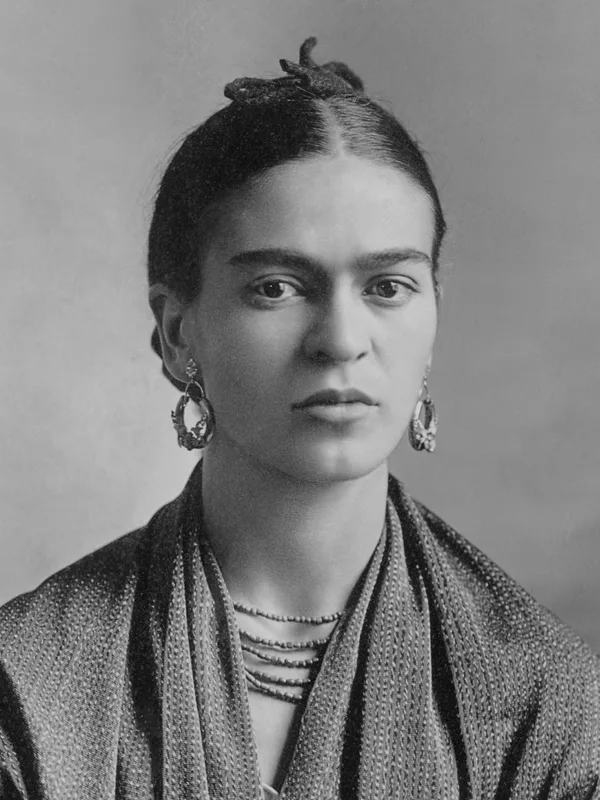

Mexican painter known for uncompromising, brilliantly coloured self-portraits exploring identity, the body and death — including The Two Fridas (1939).
Early Life
Magdalena Carmen Frida Kahlo y Calderón was born on 6 July 1907 in Coyoacán, then a town on the southern edge of Mexico City, the daughter of the German-born photographer Guillermo Kahlo and Matilde Calderón. She contracted polio at the age of six, which left her right leg thinner than her left. In 1922 she entered the National Preparatory School, intending to study medicine, and joined a group of politically minded students known as the Cachuchas. On 17 September 1925, aged eighteen, she was gravely injured when the bus she was riding collided with a tram; a metal handrail pierced her abdomen and her spine and pelvis were fractured. She spent long periods in bed and in a plaster corset, and it was during this recovery that she began to paint in earnest, using a mirror mounted above her bed to paint self-portraits. She later claimed to have been born in 1910, the year the Mexican Revolution began, so that her life would run alongside that of modern Mexico.
Education
Kahlo attended the National Preparatory School (Escuela Nacional Preparatoria) in Mexico City from 1922, where she planned to study medicine. Her formal education was interrupted by the 1925 bus accident, and she did not take a degree; she learned to paint largely on her own, with guidance from artist friends including the printmaker Fernando Fernández.
Career
Kahlo began painting seriously in 1926, during the long recovery from a bus accident the previous year, working from a specially made easel in bed. She joined the circle of the muralist Diego Rivera, whom she married in 1929, and exhibited with the Cachuchas group of young artists. In the early 1930s she lived in the United States with Rivera, painting works such as Henry Ford Hospital (1932), and returned to Mexico in 1933. Breton's visit in 1938 brought her to international attention, and her New York and Paris exhibitions followed. She divorced Rivera in 1939 and remarried him in 1940. Her health declined through the 1940s and early 1950s, with repeated operations on her spine and leg, yet she continued to paint, teach at the Escuela Nacional de Pintura, Escultura y Grabado (La Esmeralda), and keep a diary. She died at La Casa Azul on 13 July 1954, days after her 47th birthday, of a pulmonary embolism.
Achievements
Kahlo's achievement was to turn a small body of work, about 150 finished paintings of which roughly a third are self-portraits, into some of the most recognisable images of the twentieth century. Her best-known painting, The Two Fridas (1939), is a double self-portrait in which twin figures holding hands represent opposing sides of herself, one in European dress with a damaged heart and one in traditional Tehuana dress. In 1938 André Breton, visiting Mexico, declared her a natural Surrealist and helped arrange her first solo exhibition at the Julien Levy Gallery in New York; a Paris exhibition followed in 1939, where the French government bought The Frame (c. 1938). She painted her most famous works, including The Two Fridas, Self-Portrait with Cropped Hair (1940) and Self-Portrait with Thorn Necklace and Hummingbird (1940), around the time of her divorce and remarriage to Rivera. Her first solo exhibition in Mexico came in 1953, a year before her death, and she attended the opening carried in on her bed.
- Painted The Two Fridas (1939), her most famous work, a double self-portrait painted in the year of her divorce from Diego Rivera
- Held her first solo exhibition at the Julien Levy Gallery in New York in 1938, followed by an exhibition in Paris in 1939 arranged with André Breton
- Sold The Frame (c. 1938) to the French government in 1939, the first work by a twentieth-century Mexican artist acquired for a French national collection
- Produced some 150 finished paintings, about a third of them self-portraits, in a career shaped by illness and injury
- Held her first solo exhibition in Mexico in 1953, attending the opening on her bed
- Became, after her death, one of the most recognised artists of the twentieth century, with her home La Casa Azul open as a museum since 1958
Legacy
Kahlo's reputation grew far beyond her lifetime. Hayden Herrera's biography Frida (1983) brought her story to an international readership, and the 2002 film Frida made her face one of the most reproduced images in popular culture. She is now regarded as one of Mexico's greatest artists and as an icon for feminist, disability and LGBTQ audiences, whose readings of her work she did not live to see. La Casa Azul, her family home in Coyoacán, has been open as the Museo Frida Kahlo since 1958, and her paintings are held by major museums in Mexico, the United States and Europe. In 2025 her 1940 self-portrait The Dream (The Bed) sold at auction, setting a record price for a work by a female artist.
Contributions
Kahlo's contribution was to make the self-portrait a vehicle for painting pain, identity and the body without flinching. Where portraiture traditionally idealised its subject, her self-portraits record operations, miscarriages, broken columns, thorn necklaces and monkeys with a directness that owes as much to Mexican folk art and votive painting as to European modernism. She fused that folk vocabulary, Tehuana dress, pre-Columbian imagery and Catholic retablos, with a modernist eye, producing an art that is unmistakably Mexican and unmistakably her own. Her work also gave later generations a visual language for illness and disability: she painted from bed, in a corset, and made the injured body the subject rather than the obstacle of her art.
Notable Works
- The Two Fridas (1939)
- Self-Portrait with Thorn Necklace and Hummingbird (1940)
- Self-Portrait with Cropped Hair (1940)
- Henry Ford Hospital (1932)
- The Frame (c. 1938)
- The Wounded Deer (1946)
- The Dream (The Bed) (1940)
Milestones
- 1907 — Born on 6 July in Coyoacán, Mexico City Source: Encyclopaedia Britannica
- 1922 — Entered the National Preparatory School to study medicine Source: Encyclopaedia Britannica
- 1925 — Gravely injured in a bus accident; began painting during recovery Source: Encyclopaedia Britannica
- 1929 — Married the muralist Diego Rivera Source: Encyclopaedia Britannica
- 1938 — First solo exhibition at the Julien Levy Gallery, New York Source: Encyclopaedia Britannica
- 1939 — Paris exhibition; The Frame bought by the French government; divorced Rivera; painted The Two Fridas Source: Encyclopaedia Britannica
- 1940 — Remarried Rivera; painted Self-Portrait with Thorn Necklace and Hummingbird Source: Encyclopaedia Britannica
- 1953 — First solo exhibition in Mexico Source: Encyclopaedia Britannica
- 1954 — Died at La Casa Azul, aged 47 Source: Encyclopaedia Britannica
Timeline
- 6 July 1907
Born Magdalena Carmen Frida Kahlo y Calderón in Coyoacán, Mexico City
Source: Encyclopaedia Britannica - 1913
Contracted polio, which left her right leg thinner than her left
Year only — exact date unknown Source: Encyclopaedia Britannica - 1922
Entered the National Preparatory School in Mexico City, intending to study medicine
Year only — exact date unknown Source: Encyclopaedia Britannica - 17 September 1925
Gravely injured in a bus-tram collision in Mexico City; began painting during her long recovery
Source: Encyclopaedia Britannica - 1929
Married the muralist Diego Rivera
Year only — exact date unknown Source: Encyclopaedia Britannica - 1938
First solo exhibition at the Julien Levy Gallery in New York
Year only — exact date unknown Source: Encyclopaedia Britannica - 1939
Exhibited in Paris; the French government bought The Frame; divorced Rivera; painted The Two Fridas
Year only — exact date unknown Source: Encyclopaedia Britannica - 1940
Remarried Diego Rivera; painted Self-Portrait with Thorn Necklace and Hummingbird
Year only — exact date unknown Source: Encyclopaedia Britannica - 1953
First solo exhibition in Mexico, attended on her bed
Year only — exact date unknown Source: Encyclopaedia Britannica - 13 July 1954
Died at La Casa Azul in Coyoacán, aged 47, of a pulmonary embolism
Source: Encyclopaedia Britannica
Related Personalities
Frequently Asked Questions
Who was Frida Kahlo?
Frida Kahlo was a Mexican painter known for her self-portraits, vivid colours and the use of folk and indigenous imagery. She produced some 150 finished paintings, about a third of them self-portraits, in a career shaped by illness and injury.
Source: Encyclopaedia BritannicaHow did the 1925 bus accident shape Kahlo's art?
On 17 September 1925, aged eighteen, Kahlo was gravely injured when her bus collided with a tram in Mexico City. A metal handrail pierced her abdomen and her spine and pelvis were fractured. During her long recovery in bed she began to paint in earnest, using a mirror to paint self-portraits.
Source: Encyclopaedia BritannicaWhat is The Two Fridas?
The Two Fridas (1939) is a double self-portrait painted in the year Kahlo divorced Diego Rivera. Two seated figures holding hands represent opposing sides of herself: one in European wedding dress with a damaged, bleeding heart, and one in traditional Tehuana dress with an intact heart, joined by a single vein.
Source: Encyclopaedia BritannicaWho was Diego Rivera to Frida Kahlo?
Kahlo married the muralist Diego Rivera in 1929, divorced him in 1939 and remarried him in 1940. Their marriage was marked by mutual infidelity, including Rivera's affair with Kahlo's younger sister, and by a shared commitment to Mexican art and communist politics.
Source: Encyclopaedia BritannicaHow did Frida Kahlo die?
She died on 13 July 1954 in Coyoacán, Mexico City, of a pulmonary embolism. Her reputation grew far beyond her lifetime: the 2002 film Frida made her face one of the most reproduced images in popular culture. Her reputation grew far beyond her lifetime: the 2002 film Frida made her face one of the most reproduced images in popular culture.
Source: Encyclopaedia BritannicaSources & References
- Frida Kahlo — Encyclopaedia Britannica — Encyclopaedia Britannica (accessed 12 November 2026)
- Frida Kahlo — Wikipedia (cross-check) — Wikipedia (accessed 12 November 2026)
- File:Frida Kahlo, by Guillermo Kahlo.jpg — Wikimedia Commons (portrait file page) — Wikimedia Commons (accessed 12 November 2026)
- Frida Kahlo — Mother of Mexican Magical Realism — Art in Context (accessed 12 November 2026)
- A Frida Kahlo Painting Just Became the Most Expensive Work by a Female Artist Ever Auctioned — Smithsonian Magazine (accessed 12 November 2026)