Ada Lovelace
Mathematician and writer · Mathematician · Writer · Computing pioneer
1815–1852 · Born in London, England, United Kingdom · 4 min read
- Verified: 13 November 2026
- Sources: 9
- Independently reviewed
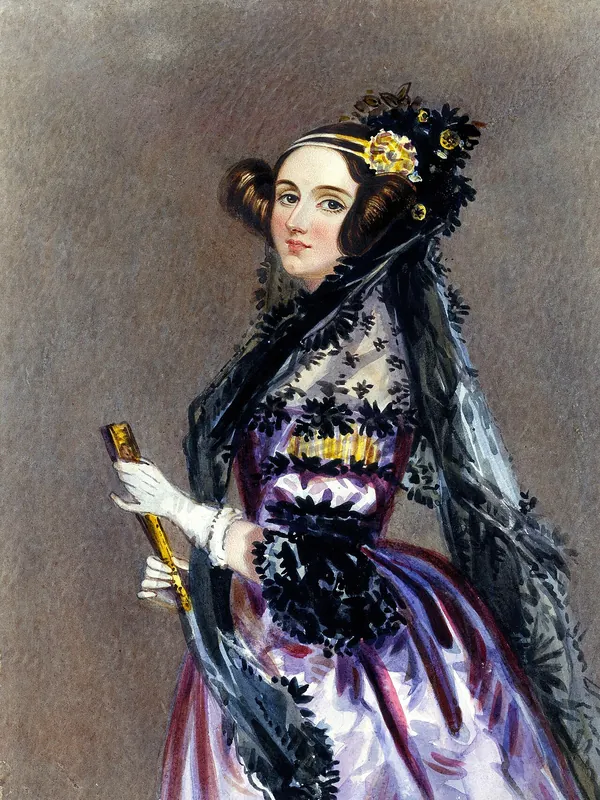

English mathematician who, in her 1843 notes on Charles Babbage's Analytical Engine, published the first program for a programmable machine and first saw that computers could work with symbols, not only numbers.
Early Life
Augusta Ada Byron was born on 10 December 1815 in London, the only legitimate child of the poet Lord Byron and Annabella Milbanke. Her parents separated two months after her birth, her father left Britain for good, and she never knew him personally. Her mother, who had studied mathematics, insisted that Ada be educated in science and mathematics rather than in poetry, and she was taught privately by tutors. As a child she was often ill, and at twelve she spent a long period bedridden, during which she designed, among other things, a steam-powered flying machine in the shape of a horse.
Education
Lovelace had no access to formal school or university education, which was not open to women of her time. She was educated privately by tutors and then largely self-educated, with help in her advanced studies from the mathematician Augustus De Morgan, the first professor of mathematics at the University of London, and from Mary Somerville, the scientist and writer who introduced her to Babbage. Her mathematical training, built up through tutoring and correspondence, was the basis of the 1843 notes.
Career
Lovelace had no formal career in the modern sense: women of her class and time were not admitted to universities or scientific institutions. Her work was done through private study, correspondence and collaboration. She met Charles Babbage in 1833, when she was seventeen, and became his collaborator and interpreter. In 1840 Babbage lectured on the Analytical Engine in Turin, and Menabrea published a French account of the lecture in 1842. At Babbage's suggestion Lovelace translated it into English and added her own notes; the translation and notes were published in August 1843 in Taylor's Scientific Memoirs, signed only with her initials, A.A.L. She continued to correspond with Babbage and with the mathematician Augustus De Morgan about the Engine and about mathematics until her health failed in the early 1850s.
Achievements
Lovelace's achievement rests on a single publication. In 1843 she published an English translation of Luigi Federico Menabrea's French paper on Charles Babbage's Analytical Engine, adding seven long notes of her own that ran to about three times the length of the paper she translated. In the notes, above all in Note G, she set out step by step how the Engine could calculate Bernoulli numbers — a procedure the Computer History Museum calls the first published description of a stepwise sequence of operations, and which is often described as the first published computer program. More important than the calculation was her argument: she saw that a machine that followed instructions could work with symbols, not only numbers, and so could compose music or manipulate letters as well as calculate. She was the first to state that idea clearly, and the Computer History Museum judges that on this point she saw further than Babbage. The programming language Ada, standardised in 1983, was named for her, and Ada Lovelace Day, on the second Tuesday of October, honours women's contributions to science, technology, engineering and mathematics.
- Published, in 1843, a translation of Luigi Menabrea's paper on Charles Babbage's Analytical Engine with extensive notes of her own, including the first published description of a stepwise sequence of operations for a machine
- Showed in Note G how the Analytical Engine could calculate Bernoulli numbers, a procedure often described as the first published computer program
- Was the first to state clearly that a programmable machine could work with things other than numbers, such as music and symbols, moving from calculation to computation
- Described the Analytical Engine as weaving 'algebraic patterns just as the Jacquard-loom weaves flowers and leaves'
- The programming language Ada, first standardised in 1983, was named in her honour
- Ada Lovelace Day, held on the second Tuesday of October, honours women's contributions to science, technology, engineering and mathematics
Legacy
Lovelace was little known in her lifetime and for a century after her death. Her 1843 notes were republished in a book on digital computing in 1952, and from the 1950s onward she came to be recognised as a founder of computing. She is often called the first computer programmer, though historians debate how much of the Bernoulli-number procedure was hers and how much came from her work with Babbage, and Babbage had drafted sample calculations of his own from 1837. What is not disputed is that her published notes were the first detailed public account of how a programmable machine could be made to carry out a long calculation, and the first clear statement that such machines could work with symbols as well as numbers. She died on 27 November 1852 in London, aged 36, of uterine cancer, and was buried, at her request, beside her father in the Byron family vault at Hucknall, Nottinghamshire.
Contributions
Lovelace's contribution was conceptual rather than mechanical. Babbage designed the Analytical Engine; Lovelace explained what such a machine could mean. Her notes showed that a machine following a sequence of instructions could be made to perform a long calculation, and she argued that the same machine could manipulate symbols — music, letters, patterns — and not only numbers. That move, from calculation to computation, is the idea on which general-purpose computing rests. She also gave the clearest early account of the limits of machines, writing that the Engine 'has no pretensions whatever to originate anything' and can do only what it is instructed to do, an argument later called Lady Lovelace's Objection.
Notable Works
- Translation and Notes on Menabrea's 'Sketch of the Analytical Engine Invented by Charles Babbage' (1843)
- Note G: calculation of Bernoulli numbers (1843)
Milestones
- 1815 — Born on 10 December in London, the only legitimate child of Lord Byron and Annabella Milbanke Source: Encyclopaedia Britannica; Wikipedia
- 1816 — Her parents separated; her father left Britain for good Source: Encyclopaedia Britannica
- 1828 — Designed a steam-powered flying machine in the shape of a horse while bedridden with illness Source: Wikipedia (cross-checked)
- 1833 — Met Charles Babbage, introduced by Mary Somerville, and saw his Difference Engine demonstrated Source: Encyclopaedia Britannica; Computer History Museum
- 1835 — Married William King, 8th Baron King, on 8 July; became Countess of Lovelace when he was made an earl in 1838 Source: Encyclopaedia Britannica
- 1836 — Birth of her first child, a son, Byron, on 12 May 1836 Source: MacTutor History of Mathematics (University of St Andrews); Bodleian Libraries, University of Oxford
- 1837 — Birth of her daughter Anne Isabella, called Annabella, on 22 September 1837 Source: MacTutor History of Mathematics (University of St Andrews); Bodleian Libraries, University of Oxford
- 1839 — Birth of her son Ralph Gordon on 2 July 1839 Source: MacTutor History of Mathematics (University of St Andrews); Bodleian Libraries, University of Oxford
- 1840 — Began advanced mathematical studies under Augustus De Morgan, including calculus, by correspondence Source: York University (Classics in the History of Psychology); Wikipedia
- 1842 — Menabrea's account of Babbage's Turin lectures on the Analytical Engine was published in French in the Bibliothèque Universelle de Genève in October 1842 Source: York University (Classics in the History of Psychology); Sotheby's
- 1843 — Published her translation of Menabrea's paper on the Analytical Engine with her own Notes A to G, signed A.A.L. Source: Encyclopaedia Britannica; Computer History Museum
- 1844 — Wrote to a friend of her hope for a “calculus of the nervous system” — a mathematical account of how the brain gives rise to thoughts; in January 1844 De Morgan wrote to her mother that had she been a young man he would have expected her to become “an original mathematical investigator, perhaps of first-rate eminence” Source: Wikipedia (cross-checked); Hollings, Martin & Rice, Historia Mathematica (2017)
- 1852 — Died on 27 November in Marylebone, London, aged 36, of uterine cancer; buried beside her father at Hucknall Source: Encyclopaedia Britannica; Wikipedia
- 1952 — Her 1843 notes were republished in a book on digital computing, beginning her recognition as a founder of computing Source: Computer History Museum
- 1980 — The United States Department of Defense programming language named Ada in her honour had its reference manual approved on 10 December 1980 — her birthday — as MIL-STD-1815, the number marking her birth year Source: Wikipedia; Encyclopaedia Britannica
- 1983 — The Ada programming language, named in her honour, was first standardised as Ada 83 Source: Computer History Museum
- 2009 — Ada Lovelace Day, honouring women's contributions to science, technology, engineering and mathematics, is held on the second Tuesday of October Source: Encyclopaedia Britannica
- 2015 — The bicentenary of her birth was marked by a Bodleian Library display and an Oxford symposium, and by a Science Museum exhibition in London Source: Bodleian Libraries, University of Oxford; Science Museum, London
Timeline
- 10 December 1815
Born Augusta Ada Byron in London, the only legitimate child of Lord Byron and Annabella Milbanke
Source: Encyclopaedia Britannica; Wikipedia - 1816
Her parents separated; her father left Britain for good
Year only — exact date unknown Source: Encyclopaedia Britannica - 1828
Designed a steam-powered flying machine in the shape of a horse while bedridden with illness
Year only — exact date unknown Source: Wikipedia (cross-checked) - 1833
Met Charles Babbage, introduced by Mary Somerville; saw his Difference Engine demonstrated
Year only — exact date unknown Source: Encyclopaedia Britannica; Computer History Museum - 8 July 1835
Married William King, 8th Baron King; became Countess of Lovelace when he was made an earl in 1838
Source: Encyclopaedia Britannica - 12 May 1836
Birth of her first child, a son, Byron
Source: MacTutor History of Mathematics (University of St Andrews); Bodleian Libraries, University of Oxford - 22 September 1837
Birth of her daughter Anne Isabella, called Annabella (later Lady Anne Blunt)
Source: MacTutor History of Mathematics (University of St Andrews); Bodleian Libraries, University of Oxford - 2 July 1839
Birth of her son Ralph Gordon
Source: MacTutor History of Mathematics (University of St Andrews); Bodleian Libraries, University of Oxford - 1840-06
Resumed mathematical studies in earnest under the tutelage of Augustus De Morgan, taking up calculus
Approximate date Source: York University (Classics in the History of Psychology) - 1842-10
Menabrea's French account of Babbage's Turin lectures on the Analytical Engine was published in the Bibliothèque Universelle de Genève
Approximate date Source: York University (Classics in the History of Psychology); Sotheby's - 1843
Published her translation of Menabrea's paper on the Analytical Engine with her own Notes A to G, signed A.A.L.
Year only — exact date unknown Source: Encyclopaedia Britannica; Computer History Museum - 1844
Wrote to a friend of her hope for a “calculus of the nervous system”; De Morgan wrote to her mother praising her mathematical ability
Year only — exact date unknown Source: Wikipedia (cross-checked); Hollings, Martin & Rice, Historia Mathematica (2017) - 27 November 1852
Died in Marylebone, London, aged 36, of uterine cancer; buried beside her father at Hucknall
Source: Encyclopaedia Britannica; Wikipedia
In Their Words
“The Analytical Engine weaves algebraic patterns just as the Jacquard loom weaves flowers and leaves.” Source: Sketch of the Analytical Engine (1843), Notes by A.A.L. — From her Notes on the Analytical Engine (1843), describing what the machine could do beyond arithmetic.
Related Personalities
Frequently Asked Questions
Who was Ada Lovelace?
Ada Lovelace (1815–1852) was an English mathematician who worked with Charles Babbage on his Analytical Engine. In 1843 she published notes showing how the Engine could be programmed to calculate Bernoulli numbers, and she is often called the first computer programmer.
Source: Encyclopaedia Britannica ; Computer History MuseumWhat was the Analytical Engine?
The Analytical Engine was Charles Babbage's design for a general-purpose programmable mechanical computer, conceived in the 1830s. It was never built in his lifetime, but its design contained the essential features of a modern computer: a store for memory and a mill for processing.
Source: Encyclopaedia Britannica ; Computer History MuseumWhy is Ada Lovelace called the first programmer?
In her 1843 notes, Lovelace set out step by step how the Analytical Engine could calculate Bernoulli numbers. The Computer History Museum calls this the first published description of a stepwise sequence of operations, which is why it is often described as the first published computer program.
Source: Computer History Museum ; Encyclopaedia BritannicaWhat did Ada Lovelace see that others did not?
Lovelace argued that the Engine could work with things other than numbers: it might compose music or manipulate symbols, because numbers could stand for other things. She was the first to state this clearly, and the Computer History Museum judges that on this point she saw further than Babbage.
Source: Computer History Museum ; Encyclopaedia BritannicaHow did Ada Lovelace die?
Lovelace died of uterine cancer in London on 27 November 1852, at the age of 36, the same age at which her father, Lord Byron, had died, and the same illness. Her notes were republished in 1952, and from the 1950s she came to be recognised as a founder of computing.
Source: Encyclopaedia Britannica ; WikipediaSources & References
- Ada Lovelace — Encyclopaedia Britannica — Encyclopaedia Britannica (accessed 12 November 2026)
- Ada Lovelace — Wikipedia — Wikipedia (accessed 12 November 2026)
- Ada Lovelace — Babbage Engine, Computer History Museum — Computer History Museum (accessed 12 November 2026)
- Ada Lovelace — Celebrating 200 years of a computer visionary — Bodleian Libraries, University of Oxford (accessed 12 November 2026)
- File:Ada Lovelace portrait.jpg — Wikimedia Commons (portrait file page) — Wikimedia Commons (accessed 12 November 2026)
- Introduction to Menabrea/Lovelace (1842/1843) — Classics in the History of Psychology — York University (accessed 12 November 2026)
- Ada Lovelace — MacTutor History of Mathematics — MacTutor History of Mathematics, University of St Andrews (accessed 12 November 2026)
- The Lovelace–De Morgan mathematical correspondence: A critical re-appraisal — Historia Mathematica (Hollings, Martin & Rice, 2017) (accessed 12 November 2026)
- Celebrating Ada Lovelace’s 200th birthday — Bodleian Libraries, University of Oxford (accessed 12 November 2026)
Explore More
- More Scientists & Inventors
- Personalities from United Kingdom
- More mathematician and writers
- More mathematicians
- More writers
- More computing pioneers
- Famous people born in December
- Browse all personalities
Featured on these lists: