Rosa Parks
Civil rights activist · Seamstress
1913–2005 · Born in Tuskegee, Alabama, United States · 3 min read
- Verified: 13 November 2026
- Sources: 4
- Independently reviewed
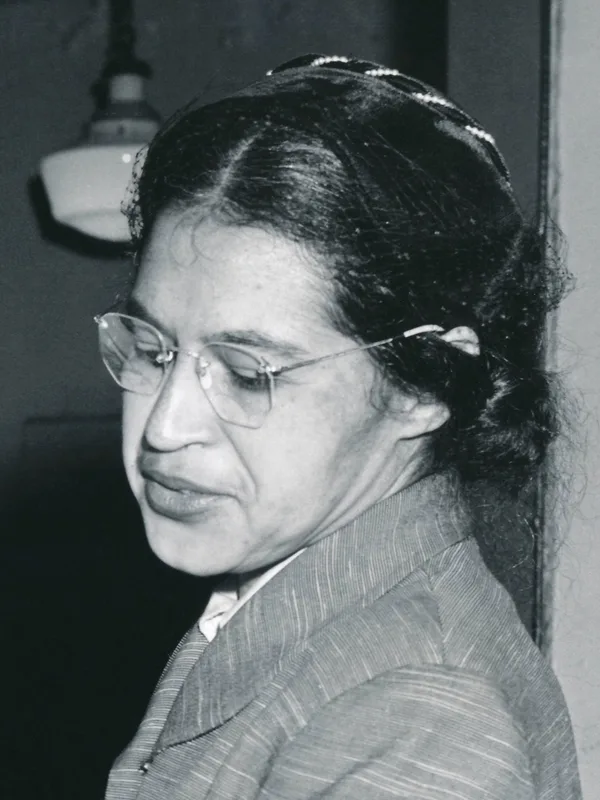

American civil rights activist whose refusal to give up her bus seat in Montgomery, Alabama, on 1 December 1955 sparked the 381-day Montgomery bus boycott.
Early Life
Rosa Louise McCauley was born on 4 February 1913 in Tuskegee, Alabama, the daughter of Leona Edwards McCauley, a teacher, and James McCauley, a carpenter. At the age of two she moved with her mother and younger brother Sylvester to her grandparents' farm in Pine Level, Alabama, where she was schooled at home by her mother until the age of eleven. She then attended the Montgomery Industrial School for Girls and later Alabama State Teachers College, leaving before graduating to care for her grandmother and then her mother. In 1932 she married Raymond Parks, a barber and civil rights activist, and the couple settled in Montgomery, where both were active in the NAACP and the Montgomery Voters League.
Education
Parks attended the Montgomery Industrial School for Girls and later studied at Alabama State Teachers College (now Alabama State University). She left college before graduating to care for family members who were ill.
Career
Parks worked as a seamstress in Montgomery, Alabama, and joined the Montgomery branch of the NAACP in 1943, becoming its secretary. She worked to register Black voters and investigated cases of racial violence, including the case of Recy Taylor in 1944. On 1 December 1955, on her way home from work, she sat in the first row of the Black section of a Cleveland Avenue bus; when the driver ordered the four Black passengers in that row to stand for white passengers, she refused and was arrested for violating the city's segregation ordinance. The Women's Political Council called a one-day boycott for the day of her trial, 5 December 1955; it became a 381-day campaign in which tens of thousands of Black residents walked, carpooled or used Black-owned taxis. The boycott ended on 20 December 1956, after the Supreme Court's ruling. In 1957 Parks moved to Detroit, where she worked for Congressman John Conyers from 1965 until her retirement in 1988 and remained active in civil rights causes until her death.
Achievements
Parks's central achievement was the act of 1 December 1955 and the movement it set off. By refusing to surrender her seat on a segregated Montgomery bus she gave the city's Black community a rallying point, and the 381-day boycott that followed, led by the Montgomery Improvement Association under the young Martin Luther King Jr., ended segregation on the city's buses after the Supreme Court ruled it unconstitutional in Browder v. Gayle in November 1956. Her later honours recognised a lifetime of activism rather than a single day: the Presidential Medal of Freedom in 1996 and the Congressional Gold Medal in 1999. After her death in 2005 she became the first woman to lie in honour at the United States Capitol, and the Library of Congress acquired her personal papers, some 7,500 items, in 2014.
- Refused to give up her bus seat on 1 December 1955, sparking the Montgomery bus boycott
- Helped sustain the 381-day Montgomery bus boycott (5 December 1955 - 20 December 1956), which ended segregation on the city's buses
- Her case was part of Browder v. Gayle, in which the US Supreme Court ruled bus segregation unconstitutional in November 1956
- Received the Presidential Medal of Freedom in 1996 and the Congressional Gold Medal in 1999
- Became the first woman to lie in honour at the United States Capitol after her death in 2005
- Published her autobiography, Rosa Parks: My Story, in 1992
Legacy
Parks is widely known as the 'Mother of the civil rights movement', a title that recognises both her 1955 stand and her decades of organising before and after it. The bus on which she was arrested, Montgomery city bus number 2857, is displayed at the Henry Ford Museum in Dearborn, Michigan. The Rosa Parks Library and Museum opened at Troy University in Montgomery in 2000, and her personal papers are held by the Library of Congress. Her story is taught as the turning point at which the modern American civil rights movement moved from courtroom challenges to mass non-violent protest.
Contributions
Parks's contribution was to turn a personal refusal into a collective campaign. The boycott she triggered showed that a sustained, disciplined economic protest by an entire community could defeat segregation, and it gave the young Martin Luther King Jr. his first national platform. Her case also advanced the legal fight: the boycott ran alongside Browder v. Gayle, the federal case that carried the principle of Brown v. Board of Education from schools to public transport. Beyond 1955, her decades of work registering voters, investigating racial violence and supporting the movement from inside Congressman Conyers's office made her a link between the Montgomery generation and the later civil rights movement.
Notable Works
- Rosa Parks: My Story (autobiography, 1992)
- Montgomery bus boycott (1955-1956)
- Secretary of the Montgomery branch of the NAACP (from 1943)
Milestones
- 1913 — Born on 4 February in Tuskegee, Alabama Source: Encyclopaedia Britannica
- 1932 — Married Raymond Parks and became active in the Montgomery NAACP Source: Congress of the United States
- 1943 — Joined the Montgomery branch of the NAACP and became its secretary Source: Library of Congress
- 1955 — Refused to give up her bus seat and was arrested, sparking the Montgomery bus boycott Source: Encyclopaedia Britannica; National Archives
- 1956 — The US Supreme Court ruled bus segregation unconstitutional in Browder v. Gayle; the 381-day boycott ended Source: Library of Congress
- 1965 — Moved to Detroit and began working for Congressman John Conyers Source: Library of Congress
- 1992 — Published her autobiography, Rosa Parks: My Story Source: Encyclopaedia Britannica
- 1996 — Awarded the Presidential Medal of Freedom Source: Library of Congress
- 1999 — Awarded the Congressional Gold Medal Source: Congress of the United States
- 2005 — Died in Detroit, aged 92; first woman to lie in honour at the United States Capitol Source: Library of Congress
Timeline
- 4 February 1913
Born Rosa Louise McCauley in Tuskegee, Alabama
Source: Encyclopaedia Britannica - 1932
Married Raymond Parks; the couple settled in Montgomery and joined the NAACP
Year only — exact date unknown Source: Congress of the United States; Encyclopaedia Britannica - 1943
Joined the Montgomery branch of the NAACP and became its secretary
Year only — exact date unknown Source: Library of Congress; Encyclopaedia Britannica - 1 December 1955
Refused to give up her bus seat in Montgomery and was arrested for violating the city's segregation ordinance
Source: Encyclopaedia Britannica; National Archives - 5 December 1955
The Montgomery bus boycott began on the day of her trial; the Montgomery Improvement Association was formed with Martin Luther King Jr. as president
Source: Congress of the United States; Library of Congress - 13 November 1956
The US Supreme Court ruled Montgomery's bus segregation unconstitutional in Browder v. Gayle
Source: Congress of the United States; Library of Congress - 20 December 1956
The boycott ended after 381 days as Montgomery's buses were desegregated
Source: Library of Congress - 1957
Moved to Detroit, Michigan
Year only — exact date unknown Source: Library of Congress; Encyclopaedia Britannica - 1965
Began working for Congressman John Conyers, a post she held until 1988
Year only — exact date unknown Source: Library of Congress - 1992
Published her autobiography, Rosa Parks: My Story
Year only — exact date unknown Source: Encyclopaedia Britannica - 15 September 1996
Awarded the Presidential Medal of Freedom by President Clinton
Source: Library of Congress - 1999
Awarded the Congressional Gold Medal
Year only — exact date unknown Source: Congress of the United States - 24 October 2005
Died in Detroit, aged 92; became the first woman to lie in honour at the United States Capitol
Source: Library of Congress
In Their Words
“I was not tired physically, or no more tired than I usually was at the end of a working day. I was not old, although some people have an image of me as being old then. I was forty-two. No, the only tired I was, was tired of giving in.” Source: Rosa Parks with Jim Haskins, Rosa Parks: My Story (Dial Books, 1992) — From her autobiography, Rosa Parks: My Story (1992), explaining her refusal on the bus
Related Personalities
Frequently Asked Questions
Who was Rosa Parks?
Rosa Parks (1913-2005) was an American civil rights activist whose refusal to give up her bus seat to a white passenger in Montgomery, Alabama, on 1 December 1955 sparked the Montgomery bus boycott, a 381-day protest that ended segregation on the city's buses.
Source: Encyclopaedia Britannica ; Library of CongressWhat happened on the bus on 1 December 1955?
On 1 December 1955 Parks, returning home from work, sat in the first row of the Black section of a Cleveland Avenue bus. When the driver ordered the four Black passengers in that row to stand so white passengers could sit, she refused. She was arrested for violating the Montgomery City Code on segregated seating.
Source: Encyclopaedia Britannica ; National ArchivesHow long did the Montgomery bus boycott last?
The boycott lasted 381 days, from 5 December 1955 to 20 December 1956. Black residents of Montgomery walked, carpooled or used Black-owned taxis rather than ride segregated buses, and it ended after the US Supreme Court ruled bus segregation unconstitutional in Browder v. Gayle.
Source: Library of Congress; Encyclopaedia BritannicaWhat honours did Rosa Parks receive?
She received the Congressional Gold Medal in 1999, the highest civilian honour Congress awards, and in 2005 became the first woman to lie in honour at the US Capitol. She is widely known as the 'Mother of the civil rights movement', a title that recognises her decades of organising before and after 1955.
Source: Library of Congress; Congress of the United StatesWhen did Rosa Parks die, and where are her papers?
She died in Detroit on 24 October 2005, aged 92. Her refusal to give up her bus seat sparked the 381-day Montgomery bus boycott. She became the first woman to lie in honour at the United States Capitol. Her papers are held at the Library of Congress.
Source: Library of CongressSources & References
- Rosa Parks — Britannica Kids — Encyclopaedia Britannica (accessed 12 November 2026)
- Authorizing the Award of a Congressional Gold Medal to Rosa Parks — Congressional Record, Vol. 145, No. 53 — Congress of the United States (accessed 12 November 2026)
- Rosa Parks being fingerprinted, 22 February 1956 — Smithsonian collections record NPG.2013.76 — Smithsonian National Portrait Gallery (accessed 12 November 2026)
- File:Rosa Parks being fingerprinted by Deputy Sheriff D.H. Lackey, 22 February 1956 — Wikimedia Commons (portrait file page) — Wikimedia Commons (accessed 12 November 2026)