Isaac Newton
Mathematician and physicist · Mathematician · Physicist · Astronomer
1643–1727 · Born in Woolsthorpe-by-Colsterworth, Lincolnshire, England · 4 min read
- Verified: 13 November 2026
- Sources: 4
- Independently reviewed
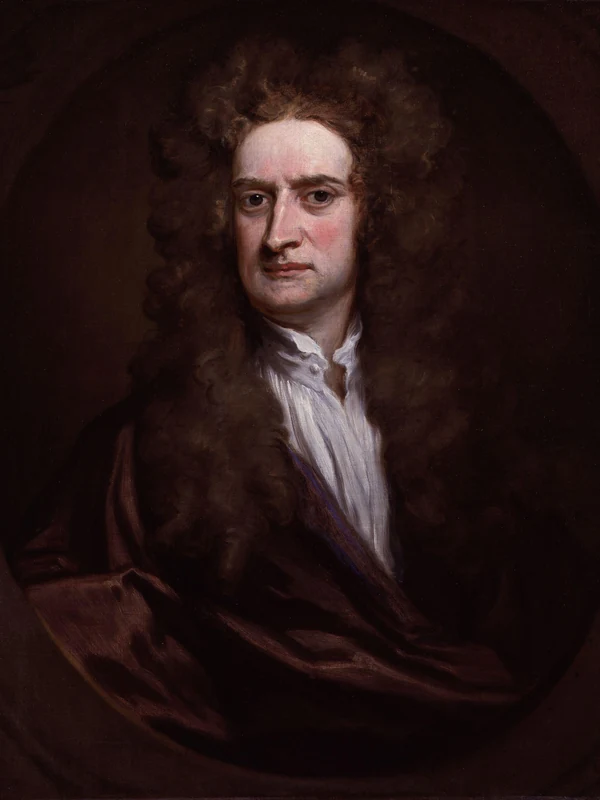

English mathematician and physicist whose Principia (1687) set out the laws of motion and universal gravitation, founding classical mechanics.
Early Life
Isaac Newton was born at Woolsthorpe Manor in Woolsthorpe-by-Colsterworth, Lincolnshire, the only son of Isaac Newton, a yeoman farmer who had died three months before his birth, and Hannah Ayscough. He was born prematurely and was not expected to survive. When he was three his mother remarried and he was left in the care of his grandmother. He was educated at the King's School in Grantham, where he lodged with the apothecary William Clarke and showed an early talent for making mechanical models, sundials and kites. In June 1661 he entered Trinity College, Cambridge, where his uncle William Ayscough had studied.
Education
Newton was educated at the King's School, Grantham, and entered Trinity College, Cambridge, in June 1661. He studied the standard Aristotelian curriculum but also read the newer work of Galileo, Kepler and Descartes on his own. He took his bachelor's degree in January 1665 and was elected a fellow of Trinity College in 1667, taking his master's degree in 1668. His teacher Isaac Barrow, the first Lucasian Professor, recognised his ability and recommended him as his successor in 1669.
Career
Newton entered Trinity College, Cambridge, in June 1661 as a subsizar, a student who paid his way partly by serving others. He took his bachelor's degree in 1665, and when plague closed the university he returned to Woolsthorpe, where in under two years he began revolutionary work on calculus, optics and gravitation. He was elected a fellow of Trinity in 1667, took his master's degree in 1668, and in 1669 succeeded Isaac Barrow as Lucasian Professor of Mathematics, a chair he held until 1702. His reflecting telescope, demonstrated to the Royal Society in 1671, led to his election as a fellow in 1672, and his paper on light and colours the same year began a long career of publication and dispute. The Principia appeared in 1687, published with the financial support of the astronomer Edmond Halley. Newton served as a Member of Parliament for Cambridge University in 1689–90 and 1701–02. In 1696 he moved to London as Warden of the Royal Mint, becoming its Master in 1699, a post he held until his death. He was elected president of the Royal Society in 1703 and was re-elected every year until he died.
Achievements
Newton's central achievement was the Principia of 1687, which set out the three laws of motion and the law of universal gravitation in a single mathematical system. With those laws he explained the orbit of the Moon, the tides, the paths of comets and the motion of the planets, showing that the same gravity that pulls an apple to the ground also holds the Solar System together. Alongside this he built the foundations of calculus, worked out the theory of colour by passing sunlight through prisms, and built the first practical reflecting telescope. In later life he ran two of England's great institutions, the Royal Mint and the Royal Society, for three decades. His work set the agenda for physics for more than two hundred years, until Einstein's relativity superseded parts of it in the twentieth century.
- Formulated the three laws of motion and the law of universal gravitation in Philosophiae Naturalis Principia Mathematica (1687), founding classical mechanics
- Co-invented calculus, independently of Gottfried Wilhelm Leibniz, developing the method of fluxions
- Showed with prisms that white light is composed of the colours of the spectrum, founding the science of optics
- Built the first practical reflecting telescope in 1668
- Served as Lucasian Professor of Mathematics at Cambridge from 1669 to 1702
- Served as Warden (1696–1699) and then Master (1699–1727) of the Royal Mint, overseeing the recoinage of England
- President of the Royal Society from 1703 until his death in 1727
- Knighted by Queen Anne in 1705, the first scientist to be knighted for scientific work
Legacy
Newton is the culminating figure of the Scientific Revolution of the seventeenth century. The Principia gave physics a mathematical framework — laws of motion and universal gravitation — that explained the heavens and the Earth with the same equations, and it remained the dominant picture of the physical world until relativity and quantum mechanics. His work on optics, collected in Opticks (1704), founded the experimental study of light and colour. His long priority dispute with Leibniz over the invention of calculus embittered his later years and divided English and continental mathematics for a generation. He died in Kensington, London, on 31 March 1727, aged 84, and was buried in Westminster Abbey, the first scientist to be given that honour.
Contributions
Newton's contribution was to make physics mathematical. Before the Principia, the motion of the heavens and the motion of objects on Earth were treated as different subjects; Newton's laws of motion and universal gravitation joined them, showing that one inverse-square law governs a falling apple and the orbit of the Moon. In mathematics he developed the method of fluxions — his version of calculus — which gave scientists the tools to describe change and motion. In optics he showed that white light is a mixture of colours and built the reflecting telescope, which replaced the refracting telescope for serious astronomy. As president of the Royal Society and Master of the Mint he also shaped the institutions of British science and public life for a generation.
Notable Works
- Philosophiae Naturalis Principia Mathematica (1687)
- Opticks (1704)
- Arithmetica Universalis (1707)
- De analysi per aequationes numero terminorum infinitas (written 1669, published 1711)
Milestones
- 1643 — Born at Woolsthorpe Manor, Lincolnshire (4 January 1643 New Style; 25 December 1642 Old Style) Source: Encyclopaedia Britannica
- 1661 — Admitted to Trinity College, Cambridge, as a subsizar Source: Encyclopaedia Britannica
- 1665 — Took his bachelor's degree; the plague years at Woolsthorpe began his work on calculus, optics and gravitation Source: Encyclopaedia Britannica; Wikipedia
- 1667 — Elected a fellow of Trinity College, Cambridge Source: Encyclopaedia Britannica
- 1669 — Succeeded Isaac Barrow as Lucasian Professor of Mathematics Source: Encyclopaedia Britannica
- 1672 — Elected a fellow of the Royal Society after demonstrating his reflecting telescope Source: Encyclopaedia Britannica
- 1687 — The Principia was published, setting out the laws of motion and universal gravitation Source: Encyclopaedia Britannica
- 1689 — Served as Member of Parliament for Cambridge University (1689–90) Source: Wikipedia
- 1696 — Moved to London as Warden of the Royal Mint Source: Encyclopaedia Britannica
- 1699 — Became Master of the Royal Mint Source: Encyclopaedia Britannica
- 1703 — Elected president of the Royal Society Source: Encyclopaedia Britannica
- 1704 — Published Opticks Source: Encyclopaedia Britannica
- 1705 — Knighted by Queen Anne, the first scientist to be knighted for scientific work Source: Encyclopaedia Britannica; Wikipedia
- 1727 — Died in Kensington, London, aged 84; buried in Westminster Abbey Source: Encyclopaedia Britannica
Timeline
- 4 January 1643
Born at Woolsthorpe Manor, Lincolnshire (25 December 1642 Old Style, on the Julian calendar then used in England)
Source: Encyclopaedia Britannica - 1661-06
Admitted to Trinity College, Cambridge, as a subsizar
Approximate date Source: Encyclopaedia Britannica; Wikipedia - 1665
Took his bachelor's degree; plague closed Cambridge and he returned to Woolsthorpe, beginning work on calculus, optics and gravitation
Year only — exact date unknown Source: Encyclopaedia Britannica; Wikipedia - 1667
Elected a fellow of Trinity College, Cambridge
Year only — exact date unknown Source: Encyclopaedia Britannica - 1669
Succeeded Isaac Barrow as Lucasian Professor of Mathematics
Year only — exact date unknown Source: Encyclopaedia Britannica - 1672
Elected a fellow of the Royal Society after demonstrating his reflecting telescope; published his paper on light and colours
Year only — exact date unknown Source: Encyclopaedia Britannica; Wikipedia - 5 July 1687
The Principia was published, setting out the laws of motion and universal gravitation
Source: Encyclopaedia Britannica; Wikipedia - 1696
Moved to London as Warden of the Royal Mint
Year only — exact date unknown Source: Encyclopaedia Britannica - 1699
Became Master of the Royal Mint
Year only — exact date unknown Source: Encyclopaedia Britannica - 1703
Elected president of the Royal Society, a post he held until his death
Year only — exact date unknown Source: Encyclopaedia Britannica - 1704
Published Opticks, his collected work on light and colour
Year only — exact date unknown Source: Encyclopaedia Britannica - 1705-04
Knighted by Queen Anne at Trinity College, Cambridge
Approximate date Source: Encyclopaedia Britannica; Wikipedia - 31 March 1727
Died in Kensington, London, aged 84 (20 March 1726 Old Style); buried in Westminster Abbey
Source: Encyclopaedia Britannica
In Their Words
“If I have seen further it is by standing on the shoulders of Giants.” Source: Letter to Robert Hooke, 5 February 1676 (Royal Society) — Letter to Robert Hooke, February 1676
Related Personalities
Frequently Asked Questions
Who was Isaac Newton?
Isaac Newton (1643–1727) was an English mathematician, physicist and astronomer, the culminating figure of the Scientific Revolution. His Principia (1687) set out the laws of motion and universal gravitation, founding classical mechanics, and he also co-invented calculus and founded the science of optics.
Source: Encyclopaedia BritannicaWhy are there two different dates for Newton's birth?
England then used the Julian calendar. Newton's birth was recorded as 25 December 1642 (Old Style), which converts to 4 January 1643 in the modern Gregorian calendar. Modern biographies, including Britannica, give the New Style date of 4 January 1643. His death likewise converts from 20 March 1726 Old Style to 31 March 1727 New Style.
Source: Encyclopaedia Britannica ; WikipediaWhat is Newton's Principia?
The Principia (Philosophiae Naturalis Principia Mathematica, 1687) sets out Newton's three laws of motion and his law of universal gravitation. It showed that the same laws govern a falling apple, the orbit of the Moon and the motion of the planets, and it is widely regarded as one of the most important scientific works ever written.
Source: Encyclopaedia BritannicaDid Newton invent calculus on his own?
Newton and the German philosopher Gottfried Wilhelm Leibniz invented calculus independently in the late seventeenth century — Newton through his method of fluxions in the 1660s, Leibniz through his differential notation in the 1670s–80s. A long and bitter priority dispute followed, and historians now credit both men.
Source: Encyclopaedia Britannica ; WikipediaHow did Isaac Newton die and where is he buried?
Newton died at his home in Kensington, London, on 20 March 1727 (31 March by the modern calendar), aged 84, and was buried in Westminster Abbey. His Principia of 1687 set out the three laws of motion and the law of universal gravitation, founding classical mechanics.
Source: Encyclopaedia Britannica ; WikipediaSources & References
- Isaac Newton — Encyclopaedia Britannica — Encyclopaedia Britannica (accessed 12 November 2026)
- Isaac Newton — Wikipedia (cross-check) — Wikipedia (accessed 12 November 2026)
- Life and works of Isaac Newton — Encyclopaedia Britannica — Encyclopaedia Britannica (accessed 12 November 2026)
- File:Sir Isaac Newton by Sir Godfrey Kneller, Bt.jpg — Wikimedia Commons (portrait file page) — Wikimedia Commons (accessed 12 November 2026)
Explore More
- More Scientists & Inventors
- Personalities from United Kingdom
- More mathematician and physicists
- More mathematicians
- More physicists
- More astronomers
- Famous people born in January
- Browse all personalities
Featured on these lists: